Used Loom Buying Guide: What to Inspect and What to Pay
Floor looms sell used for $200–900; rigid heddles for $80–200. What to inspect, which red flags to walk away from, and how to price a used loom fairly.

A used loom in good working order should sell for 40 to 60 percent of its current retail price. Floor looms run roughly $200 to $900 used; rigid heddles run $80 to $250. Before buying, inspect the frame, harnesses, beater, reed, and brakes, confirm the model has parts support, and price any missing parts in.
Looms built by Schacht, Ashford, Louet, and Macomber are designed to last decades, and most of them do. The floor loom that cost $1,400 new in 2005 often appears on Ravelry today for $400 to $600 in fully functional condition with a decade of heddles and accessories included.
The challenge is knowing what to inspect and what price to accept. A loom with a missing part that the company no longer makes can cost more to restore than the sale price implies. A loom stored in a damp garage for five years may have structural issues that compromise tension across the whole warp. This guide covers the inspection, the pricing, and the questions to ask before writing a check.
Where can you find used looms for sale?
The best sources are Ravelry’s Looms for Sale group, Facebook Marketplace and guild buy-sell groups, estate sales, and annual weaving guild sales. Ravelry and guild channels carry the most reliable listings; Facebook Marketplace wins for floor looms because local pickup avoids freight.
Ravelry is the first stop. The Looms for Sale group (search “looms for sale” inside Ravelry groups) runs several listings per week across all price points. Members typically include photos, location, price, and a model name. The community polices listings well enough that wildly mispriced looms are usually challenged by other members in the thread.
Facebook Marketplace and Facebook weaving groups generate local listings that are often priced lower because the seller doesn’t want to deal with shipping logistics. Search Facebook for your city or region plus “weaving loom” and look for local guild pages. Many guilds have private buy-sell-trade groups for members, so joining a local guild often unlocks a quieter but higher-quality marketplace.
Estate sales occasionally surface complete loom setups, sometimes with years of wound bobbins, yarn stashes, and accessories included. The pricing at estate sales is often not adjusted for fiber arts markets, which means looms can appear at below-market prices. Estate sale aggregator sites like estatesales.net list upcoming sales with photos; search for “loom” in the item descriptions.
Weaving guild sales happen annually in most larger cities. The HGA (Handweavers Guild of America) maintains a guild locator at weavespindye.org. Guild sales are low-risk because sellers are typically experienced weavers who maintained their equipment and can answer specific questions about the loom’s history.
Craigslist and eBay are lower-priority for floor looms but workable for rigid heddles. Rigid heddles ship economically when disassembled; floor looms do not.
How much should you pay for a used loom?
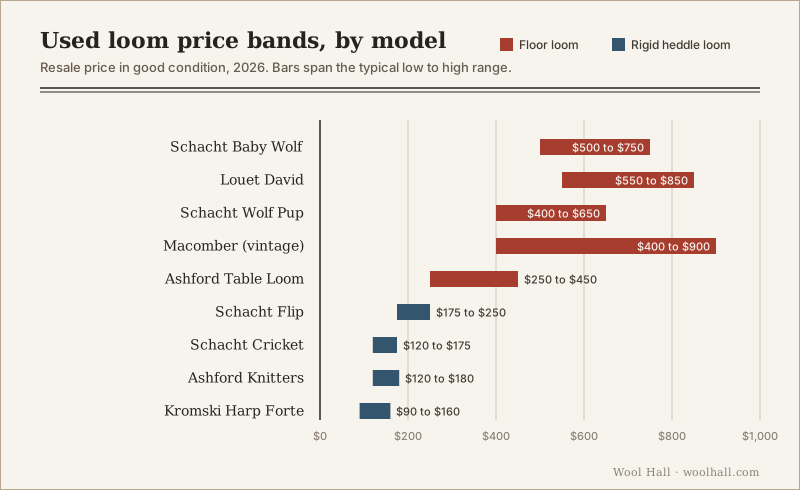
A used loom in good working condition with all parts and standard accessories should sell for 40 to 60 percent of its current retail price. The tables below give concrete bands by model so you can anchor any offer to real numbers.
New prices are the reference point. A loom that needs cleaning but is structurally sound and complete drops to 30 to 50 percent of retail. A loom missing parts or with damage is a project; price it accordingly.
Floor looms
| Model | New retail (approx.) | Used (good condition) | Used (project) |
|---|---|---|---|
| Schacht Baby Wolf (4-shaft) | $1,500–$1,700 | $500–$750 | $200–$350 |
| Schacht Wolf Pup (4-shaft) | $1,200–$1,400 | $400–$650 | $175–$300 |
| Louet David (4-shaft) | $1,600–$1,900 | $550–$850 | $200–$400 |
| Ashford Table Loom (4-shaft) | $700–$850 | $250–$450 | $100–$200 |
| Macomber (4-shaft, vintage) | Out of production | $400–$900 | $150–$350 |
| Leclerc Nilus (4-shaft, vintage) | Out of production | $300–$700 | $100–$250 |
Rigid heddle looms
| Model | New retail (approx.) | Used (good condition) | Used (project) |
|---|---|---|---|
| Schacht Cricket 15” | $250–$280 | $120–$175 | $60–$100 |
| Schacht Flip (folding, 15”) | $375–$420 | $175–$250 | $80–$130 |
| Ashford Knitters Loom 20” | $280–$320 | $120–$180 | $60–$110 |
| Kromski Harp Forte 16” | $200–$240 | $90–$160 | $50–$90 |
| Rigid heddle (generic/unknown brand) | N/A | $40–$80 | $20–$50 |
What should you inspect on a used floor loom?
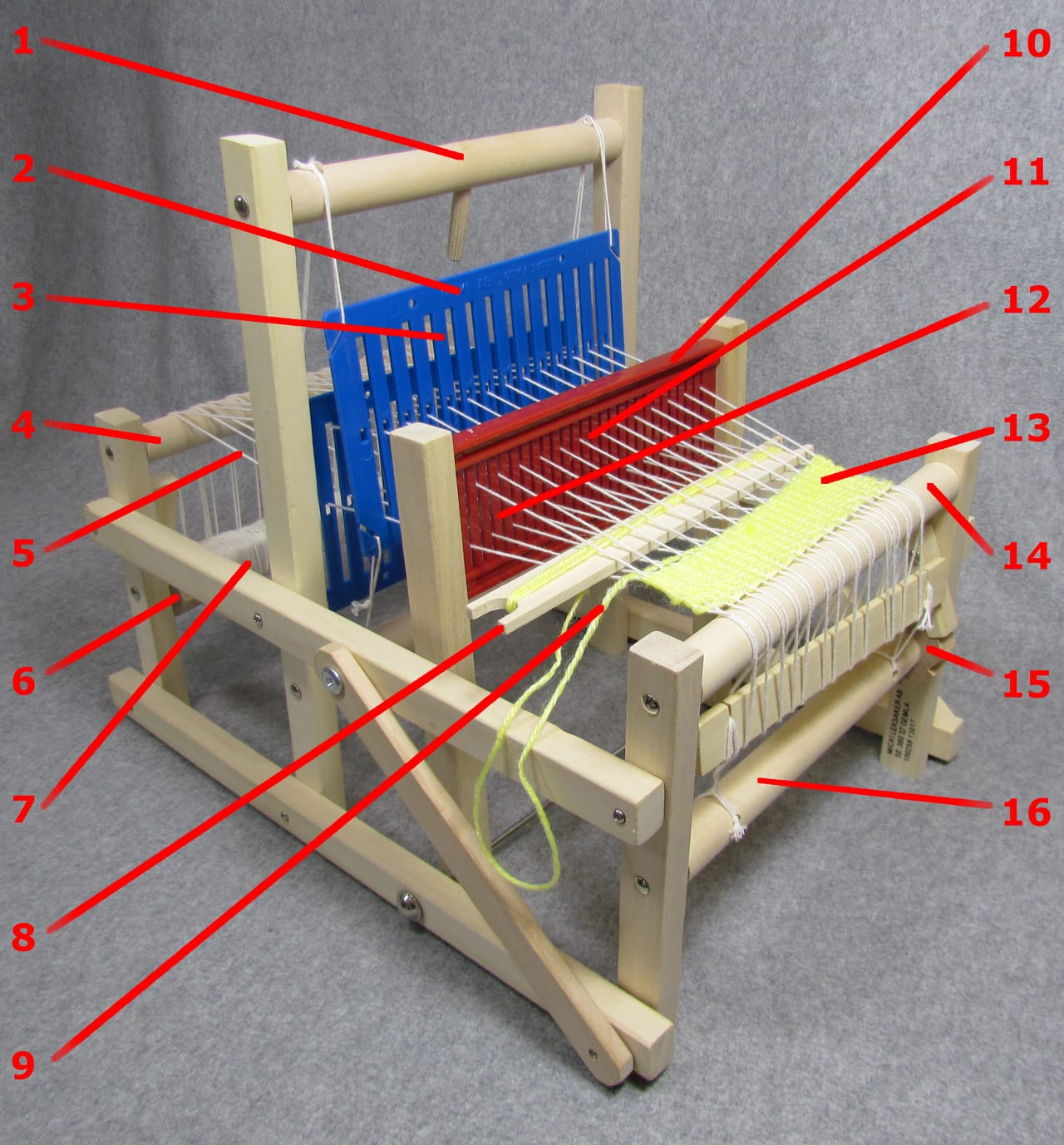
Check the frame, beater, harnesses, treadles, and beams in that order. The frame must be square with tight joints; harnesses should travel smoothly; the reed should be straight; and both brakes should hold under hand pressure. Work through this checklist in order, and if you’re buying remotely, ask the seller to video call and walk through each item.
Frame and structure
- Stand back and check that both uprights are vertical, not bowed outward or inward
- Push on the frame from both sides: no play or wobble at the joints
- Check each joint for cracks along the wood grain (common at mortise and tenon connections)
- Smell the wood: musty or mildew smell indicates moisture damage even if the surface looks dry
Beater
- Swing the beater through a full arc from back to front: it should pivot smoothly with no binding
- Check the beater pivot point for wobble (it should feel firm, not sloppy)
- Look at the reed face-on: the dents should be straight and evenly spaced with no bent or missing wires
- Confirm the reed slides in and out of the beater cap rail cleanly
Harnesses
- Raise and lower each harness individually: smooth travel with no grinding or catching
- Check that harness frames are square (not parallelogram-shaped from racking)
- Count the heddles on each harness and confirm the count matches across all harnesses (or ask what count you need for the width you plan to weave)
- Check heddle eyes for burrs (run a fingernail along the heddle eyes: smooth is what you want)
Treadles and tie-ups
- Press each treadle: it should pivot firmly and return without sticking
- Check the tie-up cords or Texsolv pegs: any that are frayed or missing should be easy to replace
- Confirm all treadles are present (some 4-shaft looms have 6 or 8 treadles; confirm against the model spec)
Beams and brakes
- Turn the warp beam: the brake should engage and hold under firm hand pressure
- Advance the cloth beam: the ratchet should click and hold without slipping
- Check that both beams are straight (sight down the beam axis: no visible bow or twist)
What comes with it Used looms often include extras that add real value: boat shuttles, stick shuttles, a warping board, lease sticks, a temple, extra reeds, or cones of leftover yarn. Ask for a complete accessory list before negotiating price.
For more on what each loom part does, the loom anatomy guide covers every component in detail.
What should you inspect on a used rigid heddle loom?
Rigid heddles have fewer parts and inspect faster: check the frame corners for cracks or flex, run a finger through every slot and hole in the heddle reed for rough edges or cracked plastic, and confirm both beams turn smoothly with a working brake.
Frame
- Check each corner for cracks or loose joints (push gently on opposite corners to feel for flex)
- Sight down the length of the frame: the front and back beams should be parallel without bow or twist
Reed
- Run a finger slowly through each slot and hole in the heddle reed: no rough edges, no cracked plastic
- Hold the reed up to a light source and look face-on: dents should be evenly spaced with no bent or missing wires
- If the reed is damaged, replacement reeds are available for most brands but add $30 to $70 to the purchase cost
Warp and cloth beams
- Rotate both beams: they should turn smoothly without catching
- Check the brake mechanism (usually a peg or click-lock): it should hold under light hand pressure
Accessories
- Heddle blocks, rigid heddle stand, extra reed, shuttle: note what’s included
For a comparison of rigid heddle vs floor loom capabilities, the rigid heddle vs floor loom guide covers width, complexity, and upgrade paths.
What are the red flags when buying a used loom?
Walk away from warped or bowed uprights, cracks running along the grain at joints, a mold or mildew odor, rust on pivot hardware, an unidentifiable model, and any listing that says “needs minor work” without specifics. Each of these signals damage or risk that costs more to fix than the price suggests.
Warped or bowed uprights. This is the single most serious structural defect. Uprights that are not vertical create uneven tension across the width of the warp and cannot be corrected without major repairs. Any visible bow in a upright is a reason to skip the loom.
Cracks at joint locations. Surface checks and dents in the wood are cosmetic. Cracks that run along the wood grain toward or from a mortise and tenon joint, a bolt location, or a pivot point are structural. A loom with a cracked upright at the harness pulley attachment is a liability.
Mold or mildew odor. Once mold penetrates into wood joints, it is very difficult to eliminate fully. A loom that smells musty will smell musty on your wool. Pass.
Rust on pivot hardware. Light surface rust on bolts or screws is cosmetic. Rust on the beater pivot pins, the treadle rod, or the harness guide tracks indicates neglect. Heavy rust means the metal has been structurally weakened.
Unknown model. A loom where the seller cannot identify the brand or model is a problem if any part ever needs replacing. Some vintage looms from defunct brands have no accessible manuals or part numbers. Confirm the model before purchasing anything that needs replacement parts.
Missing non-standard parts. Ask specifically which parts are missing and then check whether those parts are available from the manufacturer before agreeing on price. Schacht and Ashford both carry parts for current and recent models. Discontinued models from Macomber, Leclerc, or Structo may have no source for proprietary parts.
“Needs minor work” without specifics. This phrase in a listing usually means the seller does not want to list what is actually wrong. Ask for specifics: which parts, what condition, exactly what work it needs. A seller who cannot give specific answers does not know, which is itself a warning.
Which loom brands have the best used-market parts support?
Schacht and Ashford lead for parts support: both are still in business and stock parts for current and recent models. Louet supports the David and Spring, Macomber relies on an active owner community, and Leclerc parts support is inconsistent for older models.
Schacht Spindle Company (schachtspindle.com) is the best-supported option in the used market. Parts for the Baby Wolf, Wolf Pup, Flip, and Cricket are available directly from Schacht. Customer service will often identify a model from a photo and advise on parts needed. The company has been in business since 1969 and shows no sign of stopping.
Ashford Wheels and Looms (ashford.co.nz) supports their table and rigid heddle loom line with parts available direct and through dealers. The user base is global, and Ashford replacement parts are widely stocked. The Knitters Loom and SampleIt are both well-supported.
Louet (louet.com) supports the David and Spring floor looms with parts. Louet North America and Louet Europe both carry the same inventory. The David is a well-regarded beginner floor loom; see the Baby Wolf vs Louet David comparison for detail on how the two compare for weavers choosing between them.
Macomber looms are vintage (the company has changed hands over the years) but extremely well built. Parts are harder to source, but the Macomber community is active and owners regularly machine replacements or share sourcing information. A complete Macomber in good condition is a worthwhile purchase; a Macomber missing the breast beam bracket or beater assembly is not.
Leclerc (now under different management) has inconsistent parts support for older models. Current Leclerc looms have parts available; pre-2000 models are hit or miss. Ask specifically about part availability before purchasing any older Leclerc.
What should you ask a used loom seller?
Ask why they’re selling, when the loom was last used, where it was stored, the exact model and year, whether all original parts are present, what repairs were made, which accessories are included, and whether a manual exists. Specific, confident answers signal a maintained loom; vague ones warrant a closer in-person look.
Before negotiating price, ask these in order:
- Why are you selling?
- When was the loom last used, and how long has it been in storage?
- Where was it stored (conditioned space, garage, basement)?
- What is the exact model and year if known?
- Does it have all original parts, and if not, which are missing?
- Have any repairs been made, and if so, to what?
- What accessories are included (shuttles, boat shuttles, extra reeds, warping board, temple, lease sticks, stand)?
- Is there a manual, or do you know the model number for finding one?
A seller who answers specifically and confidently has been using or closely maintaining the loom. Vague answers to questions 3, 4, and 5 should increase your caution on the inspection.
Space to plan for
Before buying, confirm the loom fits your space. A Baby Wolf at 4-shaft with the bench and weaving clearance needs roughly 6 feet by 5 feet of dedicated floor space. A rigid heddle loom clamps to a table and folds flat. The space guide for looms has room dimension requirements for every loom category.