Floor Loom Anatomy: Every Part Named and Explained
Every floor loom part named and explained: warp beam, castle, shafts, heddles, beater, reed, breast beam, cloth beam, and treadles, with a labeled diagram.
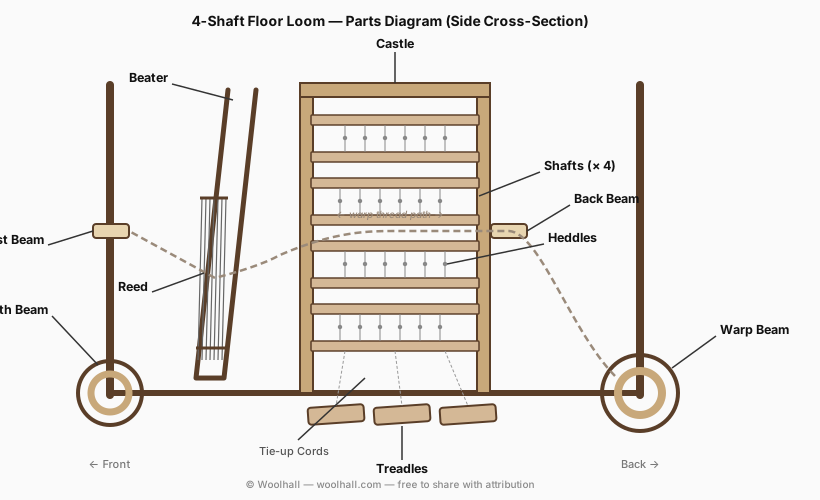
A floor loom has eleven main parts: the warp beam, back beam, castle, shafts, heddles, beater, reed, breast beam, cloth beam, treadles, and the tie-up cords linking treadles to shafts. The warp travels from the warp beam through the heddles and reed to the cloth beam in front.
Read from back to front, each part has one job. The warp beam holds the wound warp; the back beam guides the threads toward the shafts; the castle is the vertical framework that suspends the shafts above the weaving area; each shaft carries rows of heddles, small metal wires or string loops with a central eye through which one warp thread passes; the beater swings forward after each pick to pack the weft; the reed inside the beater spaces the warp threads; the breast beam guides finished cloth downward; the cloth beam winds it up; and the treadles at the floor connect by tie-up cords to the shafts to open the shed. That is the complete machine.
What do the warp beam and back beam do?
The warp beam stores the warp under tension; the back beam guides those threads up toward the shafts. The warp beam is the large drum at the rear of the loom. Before weaving begins, the entire warp (often twenty to forty yards) is wound onto the warp beam under tension, thread by thread in parallel layers. The warp does not unroll freely; a ratchet-and-pawl mechanism or friction brake holds it under tension as long as weaving is happening. To move the work forward, the weaver releases the brake, advances a measured length of warp, and re-engages it.
The back beam is the horizontal bar immediately in front of the warp beam. Threads travel from the warp beam, pass over the back beam, and rise at an angle toward the shafts. The back beam manages two things: it maintains a consistent angle as the warp transitions from a wound drum to a horizontal working surface, and it protects the wound layers on the warp beam from the friction generated when shafts move threads up and down.
On most jack looms the back beam is a fixed, smooth rod. Some countermarche looms add a second back beam to handle the warp angle from two planes. The diameter and surface finish of the back beam affects how smoothly the warp slides, which is why quality looms use well-sanded, finished hardwood or metal rods rather than rough stock.
What are the castle, shafts, and heddles?
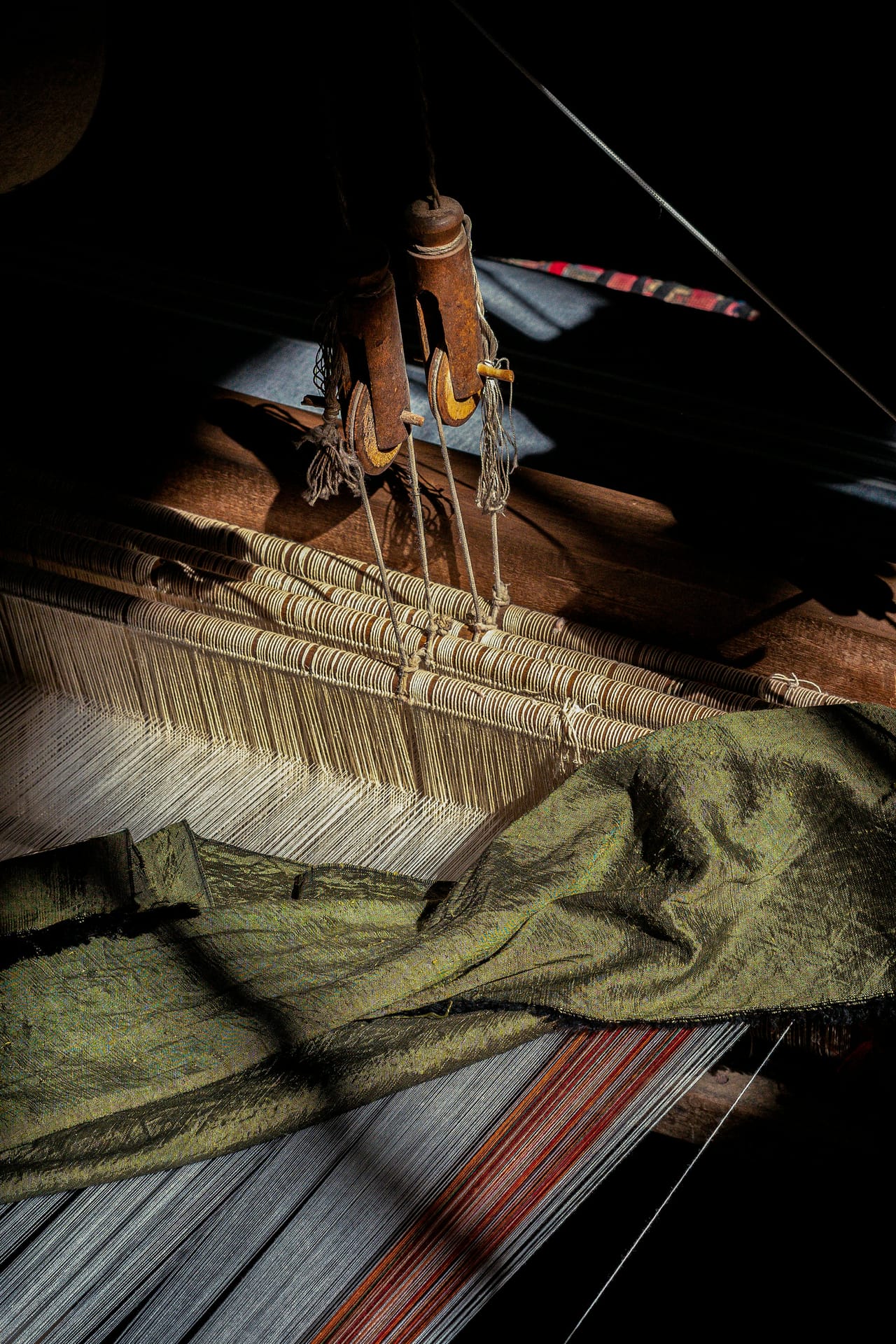
The castle holds the shafts; each shaft holds rows of heddles; each heddle threads one warp thread through its eye. The castle is the vertical framework that rises from the loom’s two side uprights and spans the full weaving width. Its sole job is to hold the shafts (one above the other, at specific heights) so they can move up or down independently without binding against each other or the castle frame. On a Schacht Baby Wolf the castle holds four shafts. On an 8-shaft loom it holds eight.
Each shaft is a rectangular frame with a top bar and a bottom bar, between which the heddles hang. The heddles are the working parts of the shaft: thin metal wires or twisted cord loops, each with a small hole in the center called the eye. Every warp thread on the loom passes through the eye of exactly one heddle on exactly one shaft. A shaft with fifty heddles controls fifty warp threads simultaneously.
When a shaft moves, all the warp threads running through its heddles move with it. A rising-shed jack loom (like the Baby Wolf or the Wolf Pup LT) raises selected shafts upward when a treadle is pressed. A sinking-shed loom lowers selected shafts instead. Either way, the motion separates the warp into two planes: threads that moved and threads that held still. That gap between the planes is the shed, and the shuttle carrying the weft passes through it.
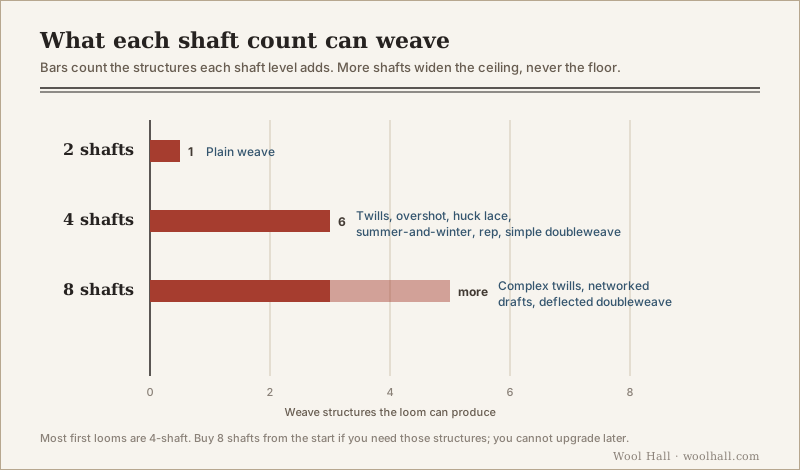
Shaft count is the primary specification to consider when buying a floor loom. Two shafts: plain weave only. Four shafts: twills, overshot, huck lace, summer-and-winter, rep weave, and most weave structures most weavers use throughout their practice. Eight shafts: 8-shaft twills, networked drafts, deflected doubleweave with greater pattern variety. The number of shafts you choose sets a ceiling on structural complexity that the loom cannot exceed.
What do the beater and reed do?
The beater is the swinging frame that holds the reed and packs each weft pick; the reed spaces the warp threads evenly across the width. The beater (also called the batten or lay) is the swinging frame mounted in front of the shafts. On most looms it pivots from the top of the castle uprights and swings in an arc toward the weaver and back with each pick. Its job has two parts: it carries the reed, and it beats.
Inside the beater sits the reed: a rectangular comb with evenly spaced vertical dents. After the warp is threaded through the heddles, each thread is also drawn through one of these dents, which spaces the warp threads uniformly across the weaving width. After every pick of the shuttle, the weaver swings the beater forward, and the lower rail of the reed presses the new weft thread down against the previous row. The line where cloth is currently being woven is the fell line.
Reed sett is measured in dents per inch. A 10-dent reed sleyed with one thread per dent gives 10 warp ends per inch. The same reed sleyed two per dent gives 20 ends per inch. Matching sett to yarn weight and weave structure is one of the first decisions in project planning. Most weavers own reeds in several setts: a 10-dpi for worsted-weight wool, a 12-dpi for sport weight, a 15-dpi for fine linen or cotton. Reeds slide out of the beater and swap in minutes.
The reed beats the cloth, but the shafts decide what structure that cloth can be. How many shafts the castle holds sets a hard ceiling on the weaves the loom can produce, and that ceiling cannot be raised after purchase.
How do the breast beam and cloth beam move the work forward?
The breast beam guides warp and woven cloth over the front of the loom; the cloth beam below it winds up the finished fabric as you weave. The breast beam is the horizontal bar at the very front of the working area, just in front of the weaver’s lap. Warp threads pass over it on their way to the fell line, and woven cloth passes over it on the way to the cloth beam. Many weavers rest their forearms on the breast beam between picks.
The cloth beam is the drum below the breast beam. As cloth accumulates, the weaver takes up by engaging the cloth beam’s ratchet, rolling the finished fabric onto the drum. This keeps the fell line close to the breast beam and maintains a consistent shed depth. The take-up interval, typically every three to six picks, becomes automatic after a few hours at the loom.
The warp beam at the back and the cloth beam at the front work in tandem. The weaver advances the warp from the back by releasing the warp beam brake, then takes up the new cloth at the front. Both happen simultaneously during the advance step, usually every inch or two of weaving. Consistent tension across both operations keeps the cloth even.
What do the treadles and tie-up cords do?
Treadles are the foot pedals that raise or lower shafts; tie-up cords connect each treadle to the shafts it controls, set per the weave draft. Treadles are the horizontal foot pedals at the base of the loom. A 4-shaft Baby Wolf ships with six treadles; the Louet David III ships with ten. The number of treadles sets the number of unique shaft-combination steps available in one complete weave sequence without re-tying.
Tie-up cords connect each treadle to one or more shafts. Before starting any new project, the weaver re-ties the cords according to the weave draft’s treadle assignments. The tie-up is draft-specific: a plain weave tie-up on a 4-shaft loom assigns shaft 1 and 3 to treadle 1, and shafts 2 and 4 to treadle 2. An overshot tie-up might assign a different shaft combination to each of six treadles.
On a jack loom pressing a treadle raises the connected shafts. On a countermarche loom pressing a treadle simultaneously raises some shafts and lowers others. The anatomy of the treadle connection is the same in both cases; what changes is whether the inactive shafts stay put or actively drop. Experienced weavers often prefer countermarche for the balanced shed depth it produces, particularly on wide warps.
How does floor loom anatomy differ from a rigid heddle loom?
A rigid heddle loom collapses many of these parts into one: its single slotted-and-holed bar threads and spaces the warp at once, with no castle, separate shafts, tie-up cords, or treadles. If you are coming to a floor loom from a rigid heddle loom, some vocabulary carries over and some does not. The rigid heddle loom has a reed, and what it calls a heddle is a slotted-and-holed bar that does both jobs at once: it threads the warp into two groups and spaces the ends. On a floor loom, the reed and the heddles are entirely separate parts with entirely separate jobs. The heddles thread the warp by shaft group; the reed spaces the warp ends and beats the weft.
The rigid heddle has no castle, no separate shafts, no tie-up cords, and no treadles in the floor loom sense. Its single heddle-reed unit does what eleven separate parts do on a floor loom, which is why a floor loom can produce more complex weave structures and why the transition involves a real learning curve.
What stays the same: warp and weft, beat, fell line, tension, the back-to-front direction of weaving. The concepts map cleanly. The equipment that implements them is a different machine.