Kromski Harp Forte Review: Best-Equipped Rigid Heddle
Kromski Harp Forte review: four widths, alder wood, a built-in warping board, and the fullest accessories kit in its class. Prices verified June 2026.
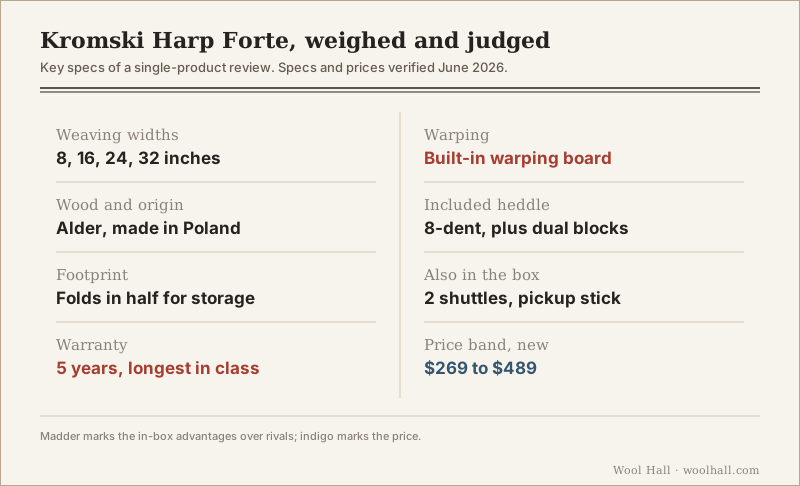
The Kromski Harp Forte is the best-equipped rigid heddle loom in its class. It comes in four widths from 8 to 32 inches, built in Poland from alder, starting around $269. Alone among its rivals, it ships with a built-in warping board, pickup stick, and double heddle blocks, plus a 5-year warranty.
That starting price covers the 8-inch clear finish, verified June 2026 at multiple dealers, and the 5-year warranty is the longest standard warranty in the category. Most beginning weavers comparing rigid heddle looms in this price range land on three candidates: the Harp Forte, the Ashford Rigid Heddle 2, and the Schacht Cricket. The comparison is genuinely close. What separates the Harp Forte is what ships in the box.
What does the Harp Forte include and what does it cost?
Every Harp Forte, regardless of width or finish, ships with:
- One 8-dent heddle (the most versatile starting dent for standard yarn weights)
- Two stick shuttles
- One pickup stick
- Threading hook
- Two warping clamps and a warping peg
- Twelve warping board pegs
- Warp helper
- Double heddle blocks
| Width | Clear finish | Walnut finish |
|---|---|---|
| 8 inches | ~$269 | ~$309 |
| 16 inches | ~$379 | ~$419 |
| 24 inches | ~$399 | ~$449 |
| 32 inches | ~$439 | ~$489 |
Prices from multiple dealers, verified June 2026. Walnut adds approximately $40 to $60 above clear pricing per width; exact amounts vary by retailer. Check Amazon and local dealers for current stock and pricing.
The 8-dent heddle is the right starting choice for most weavers working with standard commercial yarn weights. If your projects lean toward fine-weight yarn at tighter setts, the 10-dent is worth specifying at order time. Additional heddles in 5, 8, 10, and 12 dent are sold separately.
What do Harp Forte owners actually say?
Owners consistently praise the Harp Forte’s square, stable build, its smooth ratchet tension, and the convenience of the built-in warping board. The loom has been in production long enough that reports appear across Ravelry equipment forums, guild discussion boards, and weaving communities. The consistent patterns from those reports:
Build quality is reliable. Alder is a softer hardwood than maple, and the difference is visible: the Harp Forte carries a slightly warmer, lighter tone than a Schacht product. Owners report no joint integrity issues or beam warping under normal use. Loom squareness comes up frequently and consistently as a positive.
The ratchet tension system is smooth. The metal ratchet and pawl with rare earth magnets holds the warp beam locked between sheds without drift. Compared to older Kromski models with a different approach to tension, current owners find the system reliable over long weaving sessions.
The side-lock latches work well. The loom folds in half for storage. The latches that hold it open during weaving and close for folding are frequently mentioned as well-designed. The loom stays stable while treadling and folds quickly when the session ends.
The built-in warping board gets used. Owners who have used separate warping boards consistently report that the built-in version works as well and is more convenient. The main advantage: everything starts as one unit. The pegs hold warp chains securely, and the board size handles the warp lengths most rigid heddle projects require.
How does the built-in warping board change the setup process?
A warping board is what you use to measure and wind a warp before threading the loom. On most rigid heddle looms, it is a separate piece of equipment: a frame with pegs, sold for $60 to $100, that you clamp to a table or hang on a wall before every warp.
The Harp Forte builds that board directly into the back of the loom frame. The pegs are already there. You fold the board out, wind the warp on the pegs, and transfer it directly to the loom. One piece of equipment instead of two. No separate clamp, no hunting for a stable surface.
For a first-time weaver building a starter kit, this eliminates one purchase and one setup variable. For an experienced weaver who already owns a separate board, it is a convenience rather than a decision-maker. For anyone working in a tight space, not having a second clamped frame is genuinely useful.
How does the Harp Forte compare to the Ashford Rigid Heddle and Schacht Cricket?
The three most-compared rigid heddle looms at the $250 to $450 entry level are the Kromski Harp Forte, the Ashford Rigid Heddle 2, and the Schacht Cricket. All three are solidly built, widely used, and supported by established dealer networks. The differences are at the margins.
| Feature | Harp Forte | Ashford RH2 | Schacht Cricket |
|---|---|---|---|
| Wood | Alder (Poland) | Maple (New Zealand) | Hard maple (USA) |
| Built-in warping board | Yes | No | No |
| Pickup stick included | Yes | No | No |
| Double heddle blocks | Yes | Sold separately | Sold separately |
| Widths available | 8, 16, 24, 32” | 16, 24, 32” | 10, 15, 20” |
| Warranty | 5 years | Not specified | Lifetime (Schacht) |
| Amazon availability | Yes | Yes | Yes |
The Harp Forte ships more accessories than either competitor at comparable prices. The Ashford’s advantage is its deep accessory ecosystem and international dealer coverage. The Cricket’s advantage is Schacht’s US-based manufacturing and lifetime warranty, plus tight integration with Schacht’s shaft loom line if upgrading is eventually on the table.
If your primary criterion is initial value, the Harp Forte wins on what arrives in the box. If long-term accessory availability matters more, the Ashford has broader depth. If you are buying a Cricket because you plan to move to a Baby Wolf or Wolf Pup LT in a few years, the brand continuity is real.
The best rigid heddle loom guide covers the full decision tree with pricing current as of 2026.
Which width should you buy?
The 16-inch is the most purchased width and the right starting point for most weavers. It handles the projects most people make first: scarves (8 to 10 inches finished), table runners, narrow shawls, and kitchen towels (14 to 16 inches finished at typical draw-in). You can warp it in an hour and weave it in an afternoon.
The 24-inch opens up wide shawls, lap blanket panels, wider table runners, and garment yardage. If you have any realistic expectation of wanting to weave wide shawls or light blanket fabric in a single pass, starting at 24 inches avoids buying twice.
The 8-inch is a narrow specialist: inkle-style bands, straps, fingerless mitts, and samples. It is not a first loom for general weaving. Its value is as a portable second loom or for weavers who work primarily in narrow techniques.
The 32-inch handles the widest rigid heddle projects: wide blanket panels, oversized shawls, and fabric yardage. It is a substantial piece of equipment in storage; know what you need it for before buying at this size.
A useful rule: choose the width for the widest realistic project in the next two years, not the widest project you can imagine.
Is the Harp Forte worth it?
Yes, for most beginning weavers it is the strongest value in its class. At the 16-inch width, the Harp Forte costs approximately $379, and no comparable rigid heddle loom ships with more included accessories at that price. The built-in warping board removes one likely additional purchase. The double heddle blocks extend the pattern range when you are ready for them. The pickup stick allows pick-up stick patterns from your first project.
The 5-year warranty is genuine coverage. Kromski is a Polish manufacturer with a long production history in the weaving market and a US dealer network that handles warranty claims. The loom is not a disposable beginner product.
Whether it is worth choosing over the Ashford or Cricket depends on what you prioritize. Most accessories in the box: the Harp Forte is the answer. Deepest long-term accessory catalog: the Ashford. Upgrade path to a shaft loom within the same brand: the Cricket.
For a complete beginner, the rigid heddle first project guide covers what to weave and how to warp once the loom is in hand, regardless of which rigid heddle you choose.