EEW 6.1 Review: Electric Eel Wheel, $299, No-Treadle Spinner
Electric Eel Wheel 6.1 review: Dreaming Robots e-spinner, brushless 1,800 RPM motor, foot-switch speed, six 8oz bobbins, $299. No treadle or drive wheel.

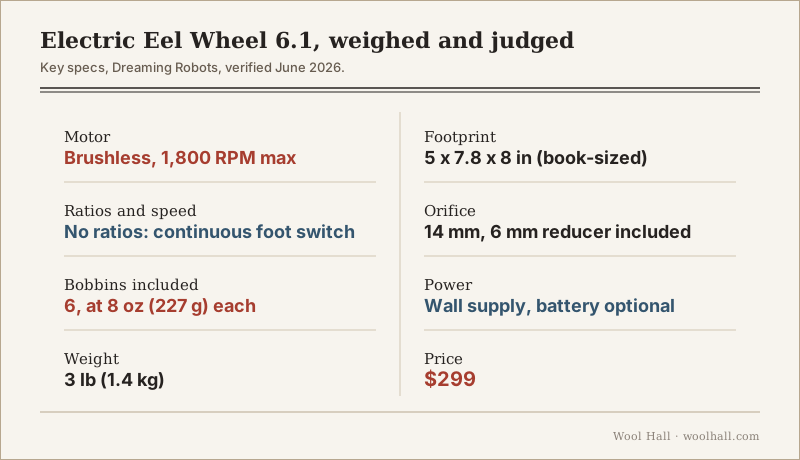
The Electric Eel Wheel 6.1 is the clearest budget e-spinner for anyone who cannot treadle or wants a portable wheel. Dreaming Robots fits a brushless 1,800 RPM motor and foot-switch speed control onto a book-sized base, with six 8oz bobbins, for $299. No treadle, no drive ratios.
It ships with a wall power supply, an orifice hook, and a 6 mm orifice reducer, and the motor runs continuous from a crawl to 1,800 RPM with no ratios to select. As of June 2026 the EEW 6.1 is backordered with a September 2026 estimated ship date. Specs verified at Dreaming Robots and The Woolery, June 2026.
| Spec | Value |
|---|---|
| Type | Electric spinner (e-spinner) |
| Motor | Brushless, 1,800 RPM maximum |
| Speed control | Foot switch (continuous variable) |
| Orifice | 0.55 in (14 mm); 6 mm reducer included |
| Bobbins included | 6 (8 oz / 227 g each) |
| Weight | 3 lb (1.4 kg) per manufacturer |
| Dimensions | 5 in W x 7.8 in L x 8 in H |
| Power | Wall supply included; battery pack optional |
| Maker | Dreaming Robots |
| Price | $299 |
| Availability | Backordered; September 2026 estimate |
What is the Electric Eel Wheel 6.1 and who makes it?
The Electric Eel Wheel is made by Dreaming Robots, a small company focused on electric spinning tools. The 6.1 is the current production model. The minor version number (6.0 to 6.1) reflects an iterative update to the same generation rather than a full redesign.
The device has no drive wheel, no footman, and no treadle. The flyer assembly mounts directly to the motor housing, which sits on a compact wooden base you can set on any table. The foot switch plugs into the motor controller; pressing it starts the motor and variable foot pressure controls how fast the flyer spins. Both hands stay free to draft fiber.
The EEW occupies a specific gap in the market: a wheel that does not require sustained foot coordination, takes up roughly the footprint of a hardback book, and costs a fraction of a traditional wheel at comparable performance. The Ashford Kiwi 3 is $799. The Schacht Ladybug is $1,047. The EEW 6.1 is $299.

How does an e-spinner like the EEW 6.1 differ from a treadle wheel?
A treadle wheel converts the back-and-forth foot motion into flyer rotation through a large drive wheel and a whorl. The spinner sets the ratio by choosing which whorl to mount (a 6.5:1 whorl vs. a 10.5:1 whorl, for example), then controls speed within that ratio by varying treadle pace. The large wheel stores momentum between treadle strokes, which gives the flyer a smooth, continuous rotation.
An e-spinner has none of that. A brushless motor turns the flyer shaft directly. There are no whorls, no drive band, no preset ratios. The foot switch acts as a variable speed controller: light pressure spins the flyer slowly; full pressure spins it at maximum RPM. Between zero and 1,800 RPM, the speed is entirely at your foot.
The trade-off is real. A treadle wheel gives you a physical rhythm, foot pushing down, body responding, that many spinners find meditative and self-reinforcing. An e-spinner removes that rhythm entirely. For some spinners, that is a relief; for others, it is the whole reason they spin. If the treadle rhythm is part of why you want to spin, the EEW will not give you that.
The practical reasons people choose an e-spinner:
- Repetitive strain or chronic pain that makes sustained treadling difficult
- Balance, hip, or joint conditions that limit rhythmic foot motion
- Space constraints where a 10-30 pound floor loom is not feasible
- Portability (particularly with the optional battery pack)
- Price ($299 vs. $799-$1,047 for entry-level treadle wheels)
What are the EEW 6.1’s specs: motor, orifice, bobbins, and power?
The motor is brushless. Brushless motors run cooler, quieter, and longer than brushed motors because they have no carbon brushes wearing against a commutator. For a tool that may run for hours at a stretch, this matters. Maximum speed is 1,800 RPM, reached at full foot-switch depression.
The orifice is 0.55 inches in diameter (approximately 14 mm). A 6 mm reducer is included, narrowing the opening for finer singles and making it harder to lose the leader while threading. The 14 mm standard orifice is generous for an e-spinner and comfortable for bulky fiber and art yarn.
Six bobbins come in the box. Each holds up to 8 ounces (227 grams). On a project using 4 oz of fiber per skein, you can fill a bobbin and have enough for a second project before winding off. For spinners who batch-spin, this is a meaningful included quantity.
The standard power source is a wall supply included with the wheel. The optional battery pack from Dreaming Robots makes the EEW cordless, which is the main argument for true portability. Without the battery pack, the foot-switch cable and power cord are the practical anchor points.
Weight: 3 pounds per the Dreaming Robots product page. (The Woolery lists 2.0 pounds. Where manufacturer and dealer specs disagree on a physical specification, the manufacturer number is authoritative. When the wheel arrives, it weighs what the manufacturer measured.)
Dimensions: 5 inches wide, 7.8 inches long, 8 inches tall. Those numbers are smaller than they read. The EEW 6.1 fits in a tote bag.

What fiber types can you spin on the EEW 6.1?
The EEW 6.1’s orifice range (6 mm with reducer, 14 mm standard) and fully variable motor cover a wide span of fiber types.
Fine combed tops (Merino, BFL, Rambouillet, Corriedale) spin well on the standard orifice with the reducer in, keeping the leader stable and the twist from escaping between drafts. Bulky singles, thick-and-thin art yarn, and core-spun yarn exit through the standard 14 mm orifice without the reducer.
The variable foot switch changes the practical approach to spinning different weights. On a treadle wheel, you change whorls to shift ratios for bulky versus fine work. On the EEW, you adjust foot pressure. Light pressure at slow speed lets you draft fast for bulky yarn; sustained moderate pressure for consistent fine singles. The adjustment is more analog and less mechanical.
The EEW 6.1 does not have a built-in plying mode or separate bobbin winder. For plying, you need a separate lazy kate (not included). The bobbins load onto the lazy kate and feed into the EEW as you ply. If you use a drum carder to prep fiber before spinning, the EEW handles the resulting batts without difficulty on the standard orifice.
What does the EEW 6.1 come with, and what are the main accessories?
Included in the box:
- Motor unit and wooden base
- Foot switch with cable
- Wall power supply
- Six 8-ounce bobbins
- Orifice hook
- 6 mm orifice reducer
- Instruction manual
Accessories sold separately by Dreaming Robots:
- Battery pack: the main portability upgrade; makes the EEW cordless for studio, travel, or outdoor use
- Additional bobbins: same 8-ounce format; useful for working across multiple color runs without winding off
- Lazy kate: floor stand for plying; not included with the wheel
There is no official lazy kate from Dreaming Robots as of June 2026; most spinners use a universal lazy kate compatible with the EEW’s bobbin size, or improvise with a box and knitting needles.
Is the Electric Eel Wheel 6.1 right for you?
The case for the EEW 6.1 is clearest in a few specific situations.
If treadling is painful or impossible. Repetitive strain, arthritis, hip conditions, or chronic fatigue that makes sustained rhythmic foot motion difficult or impossible. The EEW separates twist insertion (motor) from drafting (hands). The foot switch requires much lighter and less rhythmic pressure than a treadle. This is the single strongest argument for an e-spinner over a treadle wheel.
If space is the constraint. The EEW 6.1 is 5 x 7.8 x 8 inches and 3 pounds. It lives on a side table, a nightstand, or inside a tote bag. A treadle wheel needs 2-3 square feet of floor space at minimum.
If price is the primary factor. At $299 the EEW is the least expensive path to a motorized spinning setup with six bobbins and a useful orifice range. The Ashford Kiwi 3 starts at $799; the Schacht Ladybug is $1,047.
If portability matters. With the optional battery pack, the EEW becomes a take-anywhere tool. Spinning at a guild meeting, at a campsite, in a hotel room: all genuinely possible without hauling a 12-pound treadle wheel.
Think twice if you want the physical rhythm of a treadle wheel. Many spinners find the rhythmic foot-push meditative and integral to why they spin. The EEW removes that entirely. No amount of foot-switch adjustment replicates it.
Think twice also if you want a craft object that functions as furniture. A Schacht Wolf Pup or a traditional Saxony wheel is a visual piece. The EEW 6.1 is a tool that looks like a motor because that is what it is.
One timing consideration: as of June 2026, the EEW 6.1 is backordered with a September 2026 ship estimate. If you want to start spinning sooner, a drop spindle teaches the core drafting skills that transfer directly to the EEW and costs under $30. You could spin for three months on a spindle, develop drafting muscle memory, and have the EEW arrive in time to put those skills to immediate use.
For spinners who cannot treadle, or who need a tool that fits a bag and costs under $300, the EEW 6.1 is the clearest option at this price.