E-Spinner vs Treadle Wheel: Which Should You Choose?
E-spinners spin anywhere with no treadling; treadle wheels give the full ritual. Portability, price, and drive-system trade-offs for every spinner.
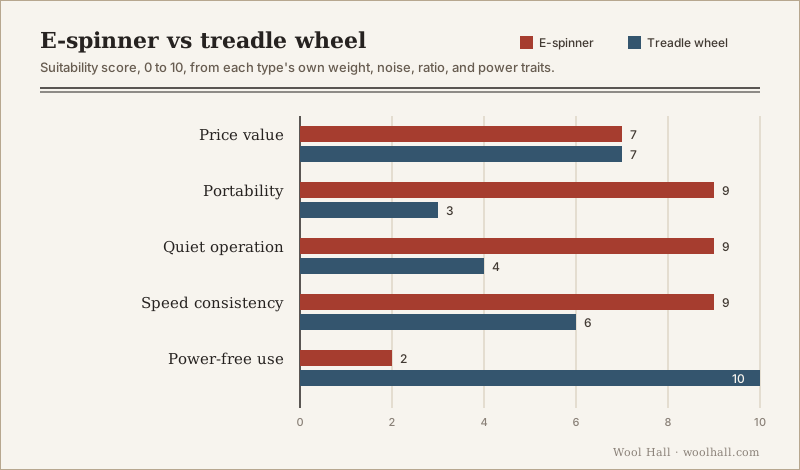
Choose an e-spinner for portability, quiet apartment use, and consistent motor-driven speed; choose a treadle wheel for the highest drive ratios, power-free spinning, the resale market, and the physical rhythm many spinners love. Prices overlap, so this is a fit decision, not a budget one. Both spin fiber equally well.
Hobbyist e-spinners started appearing around 2010, and by 2020 the EEW, Hansen miniSpinner, and Ashford e-Spinner 3 had become a legitimate alternative to treadle wheels for production handspinning. The question is no longer “is this real” but “which one should I get,” and the answer depends on how you spin, where you spin, and what you want to feel while you do it.
What exactly is an e-spinner?
An e-spinner is a spinning wheel where the treadle, footman, and drive wheel are replaced by an electric motor. The flyer-bobbin assembly (orifice, flyer arms, hooks, bobbin, whorls) is mechanically identical to a treadle wheel’s assembly. The motor turns the flyer whorl directly through a drive belt or coupling, at a speed set by a dial or controller.
Everything the fiber sees is the same as on a treadle wheel. The fiber still drafts through your hands. It still enters through the orifice. It still winds onto the bobbin through the same tension system (scotch tension on most e-spinners). The learning curve for drafting is the same. What changes is your feet: they rest on the floor instead of treadling.
Understanding the anatomy in our spinning wheel parts guide clarifies why e-spinners work the same way: the flyer-bobbin assembly and drive system are identical concepts regardless of power source.
What is spinning on a treadle wheel like?
Treadling is a full-body, rhythmic experience: your foot drives the wheel, your hands draft, and your attention tracks the twist. Many spinners find this multi-channel engagement meditative; others find it tiring after a couple of hours.

Treadle wheels have a specific physical experience that their owners describe in consistent terms: the rhythm, the presence, the full-body engagement. You are not just spinning fiber; you are moving your foot, watching the wheel, feeling the vibration through the footman, hearing the drive band on the whorl. Some spinners call this meditative. Some call it tiring after two hours. Both descriptions are accurate depending on the person and the session length.
What treadle wheels do well:
- Drive ratios. Production treadle wheels like the Schacht Matchless reach ratios of 30:1 or higher. Most e-spinners max around 18:1 to 20:1, which handles fingering to sport weight but may not suit the finest laceweight work at production speeds.
- No power needed. A treadle wheel runs anywhere, including power-free environments. You can spin on a porch, in a cabin, at a retreat with no outlets.
- Resale market. Treadle wheels hold value well. An Ashford Kiwi 3 bought for $500 five years ago typically sells used for $300 to $400 in good condition. The e-spinner resale market is smaller and newer.
- Beginner coordination. The treadle rhythm provides a physical cadence that helps many beginners pace their drafting. Each foot stroke is a beat; experienced spinners synchronize their drafting hands to the wheel’s rotation naturally over time.
- Community. Every guild beginner class, every spinning retreat, every in-person spinning lesson assumes a treadle wheel. There is more in-person teaching infrastructure around them.
What treadle wheels don’t do well:
- Portability. Even compact wheels like the Ashford Kiwi 3 weigh 8 to 10 kg (18 to 22 pounds) and need 2 to 3 square feet of floor space. They fold or disassemble for travel, but airline travel with a spinning wheel is a significant commitment.
- Apartment living. Treadle noise (particularly the footman crank and treadle impact) carries through floors. Not a problem in a house; meaningful in a second-floor apartment.
- Physical accessibility. Treadling requires coordinated foot action. Spinners with foot, knee, or hip limitations may find treadling painful over extended sessions.
- Consistent speed. Your treadle cadence varies; the wheel speed varies with it. This affects twist insertion rate, which affects yarn consistency. Experienced spinners manage this automatically; beginners notice the variability.
What is spinning on an e-spinner like?
E-spinners eliminate the treadle coordination challenge: you set a speed dial, the motor holds that speed, and your hands do everything. Many owners describe it as “just spinning,” with more attention on the fiber and less on foot management.
What e-spinners do well:
- Portability. The EEW 6 weighs about 2 kg (4.4 lbs) and fits in a shoulder bag. The EEW Nano is under 1 kg. You can spin on a plane, in a hotel room, in a car waiting for someone. For spinners who travel and want to keep spinning, this is transformative.
- Consistent speed. The motor does not vary its pace. This produces more consistent twist insertion, which produces more consistent yarn, especially valuable for laceweight and fine-count work where twist variation is visible in the finished piece.
- Physical accessibility. No treadling. If you have a foot, knee, hip, or balance condition that makes treadling uncomfortable, an e-spinner removes that barrier completely.
- Apartment living. E-spinners are quiet enough for apartment use without disturbing neighbors. The motor hum and drive band sound are low-frequency and low-volume.
- Spinning while watching video. Because you are not treadling, you can divert your visual attention more freely. Many e-spinner owners spin in the evenings in front of a screen, something that requires more practice to do on a treadle wheel.
- Secondary wheel without the footprint. Some experienced spinners own both a primary treadle wheel for serious sessions and an e-spinner for travel, teaching, or secondary use.
What e-spinners don’t do well:
- Very high ratios. As noted, most e-spinners cap around 18:1 to 20:1. For fine wool lace spun at production speed, some treadle wheels reach higher ratios.
- The ritual. If you find treadling meditative or are drawn to the traditional practice of spinning, the motor is a subtraction, not a convenience. Some spinners explicitly choose treadle wheels because the physical engagement is the point.
- Plying large bobbins at speed. E-spinners typically have smaller bobbin capacity than full-size treadle wheels. Production plying sessions may require more bobbin changes.
- Parts and repair. The motor, speed controller, and battery are proprietary to each manufacturer. If an EEW motor fails, you need EEW parts. A broken footman or drive band on a treadle wheel can often be replaced with generic hardware or materials from any woodworking supply.
Which e-spinners and treadle wheels should you know?
The compact e-spinner field is led by the EEW, the Hansen miniSpinner, and the Ashford e-Spinner 3; on the treadle side, the Ashford Kiwi 3, Traditional, and Traveller and the Schacht Ladybug and Matchless cover beginner through production work. Here is what sets each apart.
E-spinners:
EEW 6 / EEW 6.1. Made by the German manufacturer EEW (Elektrisches Wollrad). About 2 kg. Scotch tension, adjustable whorls (ratios from about 6:1 to 18:1). USB-C rechargeable battery and AC adapter. The most commonly reviewed compact e-spinner; our EEW 6 review covers it in detail. Current street price around $600 to $750 depending on accessory kit and import taxes.
EEW Nano. EEW’s travel-focused smaller model, under 1 kg. Fewer whorl options than the 6.1; limited to lighter yarn weights at the small end of the ratio range. Designed for true backpack portability.
Hansen miniSpinner. Larger and heavier than the EEW (around 2.5 kg with accessories), but with a larger bobbin capacity and an excellent speed controller. Around $850 to $1,000. Highly regarded for production spinning and laceweight.
Ashford e-Spinner 3. Ashford’s electric option. More similar in form factor to a treadle wheel (has a drive wheel, just motor-powered) than the compact EEW or Hansen. Heavier than the EEW. Around $500 to $600. Good choice if you want to stay in the Ashford ecosystem.
Treadle wheels:
Ashford Kiwi 3. The most common beginner wheel globally. Around $400 to $550. Castle style, single treadle (convertible to double). Full Kiwi 3 review.
Ashford Traditional. Saxony style, longer history, beloved by traditional spinners. Around $500 to $650. Full Traditional review.
Ashford Traveller. Castle style, double treadle standard, wider whorl range. Around $550 to $700.
Schacht Ladybug. Compact castle wheel, double treadle, hard maple construction. Around $700 to $900. Full Ladybug review.
Schacht Matchless. The production standard. Higher ratio range than most beginner wheels, double drive option, multiple flyer configurations. Around $1,100 to $1,400.
How do e-spinner and treadle wheel prices compare?
They land in the same range. Compact e-spinners run from roughly $400 (EEW Nano) to $1,000 (Hansen miniSpinner), while treadle wheels span about $400 (Ashford Kiwi 3) to $1,400 (Schacht Matchless), so the brackets overlap heavily.
| Wheel | Type | Weight | Price range |
|---|---|---|---|
| EEW Nano | E-spinner | ~0.6 kg | $400–500 |
| Ashford e-Spinner 3 | E-spinner | ~4 kg | $500–600 |
| EEW 6.1 | E-spinner | ~2 kg | $600–750 |
| Hansen miniSpinner | E-spinner | ~2.5 kg | $850–1,000 |
| Ashford Kiwi 3 | Treadle | ~8 kg | $400–550 |
| Ashford Traditional | Treadle | ~9 kg | $500–650 |
| Ashford Traveller | Treadle | ~9 kg | $550–700 |
| Schacht Ladybug | Treadle | ~9 kg | $700–900 |
| Schacht Matchless | Treadle | ~11 kg | $1,100–1,400 |
The price ranges for e-spinners and mid-range treadle wheels overlap substantially. This is not a case of choosing the budget option vs the premium option; you are choosing between two legitimate tool types at roughly equal price points.
The decision framework
Choose an e-spinner if:
- You travel frequently and want to keep spinning
- You have a physical condition that makes treadling uncomfortable
- You live in an apartment and are concerned about treadle noise
- You already spin on a treadle wheel and want a portable secondary option
- You want to spin while watching video without mastering wheel treadling first
- You prioritize consistent speed and twist insertion over the physical ritual
Choose a treadle wheel if:
- This is your first wheel and you plan to take classes or spin with a guild
- You want the full traditional spinning experience, including the physical rhythm
- You spin for long uninterrupted sessions where treadle cadence becomes automatic
- You need the highest drive ratios (above 20:1) for fine laceweight production
- You want a wheel with a larger second-hand market for resale or used purchase
- You have no portability requirement and want the widest fiber versatility
If you are genuinely undecided and this is your first wheel: the Ashford Kiwi 3 is the standard beginner recommendation precisely because it is forgiving, well-supported, and available at every guild and beginner class. An e-spinner is a reasonable first wheel, but it is a more isolated purchase: there is less beginner infrastructure around it, and if you decide later that treadling is what you wanted, you will buy a second wheel anyway.
If you have been spinning for a year or more and are looking to add portability or reduce physical load, the EEW 6 is the most compact full-featured option at a reasonable price point for experienced spinners.
Neither type is objectively better. The best spinning wheel is the one you actually sit down and use.
Not yet ready for a wheel? The drop spindle guide covers the most portable possible entry point: no motor, no treadle, fits in a bag.